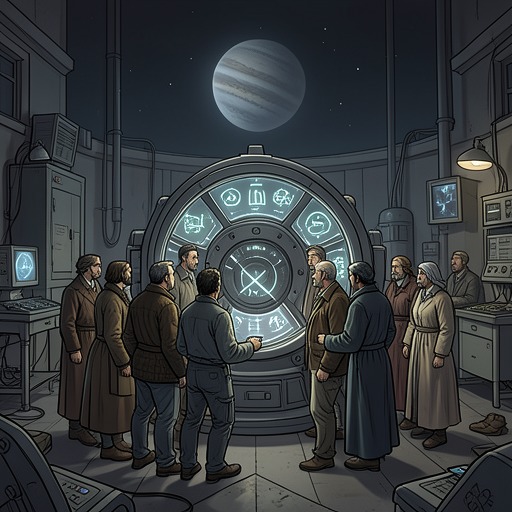
International Society of Odonians
The DispossessedThe International Society of Odonians is the organization to which the Council of World Governments grants Anarres after the collapse of Thu’s government. The transfer makes possible the Odonians’ settlement on the Moon while also serving as a political bargain intended to protect the authority of law and national sovereignty on Urras. The society’s founding thus joins a project of voluntary social transformation to the imposed boundary of a closed settlement, a tension that returns when Shevek arrives on Urras empty-handed and later argues that knowledge, too, should be a gift rather than a commodity.
Formation and Settlement
Before the Odonians’ arrival, Anarres had been explored and mined but not colonized. Urras’s exhausted metal lodes made lunar mining profitable; the settlement at the foot of the Ne Thera Mountains, called Anarres Town, housed male miners and technicians on temporary assignments, not a society intended to endure. Separately, Thu maintained a secret eastern-hemisphere rocket base and a settlement of gold miners whose families lived on the Moon without the other governments’ knowledge.
When Thu’s government collapsed in 771, the Council of World Governments proposed giving the Moon to the International Society of Odonians. The stated political calculation was to buy off a movement that threatened to weaken law and national sovereignty on Urras before it could do fatal damage to their authority. Anarres Town was evacuated, and rockets sent amid the upheaval in Thu to retrieve the gold miners; some chose to remain on the Moon. The episode therefore places the Society’s new home within an already contested history of mining, secret occupation, and intergovernmental power.
Migration and the Closed Port
The Council granted the Odonians twelve ships. For more than twenty years they travelled between Urras and Anarres, carrying the million people who chose the new life across the intervening abyss. Anarres Town, which by then held a hundred thousand residents, was renamed Abbenay, meaning Mind in the new society’s language. Once the migration was complete, the port was closed to further immigration and left open only to freight ships operating under the Trade Agreement.
That closure makes the settlement more than a relocation: it establishes a controlled threshold between the two worlds. Much later, the Terms of the Closure are invoked to bar anyone arriving from Urras from leaving the freight ships beyond the Port of Anarres. The rule exposes the asymmetry of the boundary: a person may leave Anarres if a propertarian freighter will take them, but return is not assured. The Society’s founding arrangement thus remains active as a restriction on movement, even as the original mass migration recedes into history.
Odonian Principles and Material Practice
The Society’s presence on Urras is also tested in everyday exchange. When Shevek arrives on the Mindful, he has brought nothing and no money, because neither money nor the expectation of gifts belongs to the Anarresti way of life. He calls himself the Beggarman: in a society where survival depends on what others provide, he asks his hosts to give rather than sell. His empty hands make the difference between the two systems concrete, turning hospitality into a question of whether one can receive without being made a customer or debtor.
At a later meeting, Shevek repeats the image to Atro and Saio Pae, saying that he has come as a good Odonian with empty hands. They assure him that he is their guest and that no payment is expected; Chifoilisk counters that the Ioti Government is paying the bill. The exchange leaves open who is actually giving and who controls the terms of reception. Shevek’s conduct makes the Society’s ethic legible not as an abstract doctrine but as a pressure placed on the commercial assumptions of his hosts.
Political Representation and the Gift of Knowledge
The organization’s social experiment is also vulnerable to representation by outsiders. A Urrasti newspaper prints a photograph of Shevek beside the spaceship, labels him the “FIRST MAN FROM THE MOON!” and supplies a speech welcoming a new era of friendship that he says he never gave. The reporter’s invented words convert a visitor from the Society into a reassuring emblem of official interplanetary harmony. Shevek’s protest and Pae’s explanation reveal how easily the public meaning of the encounter can be manufactured by those who control its publicity.
Shevek later makes the Society’s challenge to commercial exchange explicit in his dealings with Urras. He says he came to bargain for his people to come out of exile, seeking solidarity and free exchange between Anarres and Urras. Yet his most decisive demand rejects the idea that all exchange must be a sale: he asks whether there can be a gift, and offers his theory to Urras, Hain, and the other worlds for the common good, rather than for one country to turn it into power, profit, or an advantage in war. The International Society of Odonians is not itself described as directing this offer; rather, its practice of non-monetary giving supplies the ethical contrast through which Shevek makes the offer’s political meaning clear.
Boundaries, Power, and Significance
The book sets the Society’s aspiration to free association against institutions that control passage and speech. On Urras, an official explains that the declared state of war brings research classification, possible publication delays, and restrictions on non-national researchers’ travel, including a rule against leaving campus without clearance. At Capitol Square, police helicopters drown out a crowd and fire on the people gathered there; in the Directorate’s foyer, a word is smeared in blood on the wall. These scenes do not establish the Society as an actor in Urrasti state policy, but they sharpen the political stakes of the system Shevek confronts: governments and property regimes can regulate movement, knowledge, and public action.
At the Terran embassy in Rodarred, Shevek is told that the castle counts as Terran soil, a diplomatic fiction that makes one world’s territory appear inside another. The image of a legally recognized enclave echoes the more consequential boundary around Anarres: both show how rules can define who may enter, leave, or claim protection. Across these contrasts, the International Society of Odonians signifies both the possibility of a society organized around shared life and the danger that its separation may harden into exclusion. Its founding bargain provides a refuge for a new experiment, but the closed port ensures that the experiment’s relation to the rest of the worlds remains politically unsettled.